




WAM GmbH supplies versatile, high‑quality rotary valves for virtually every application environment
Types and design of rotary valves
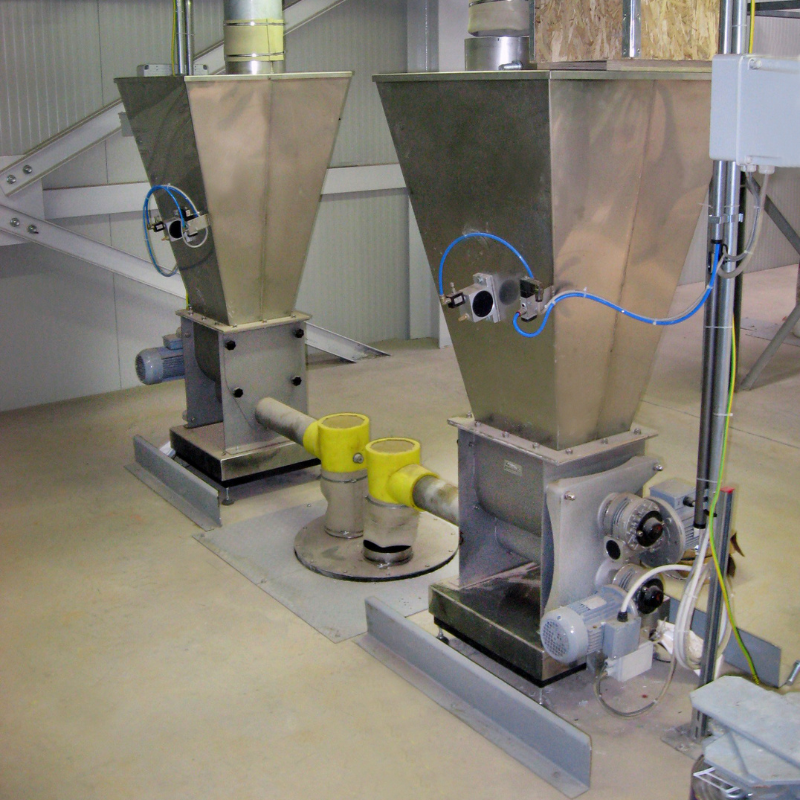
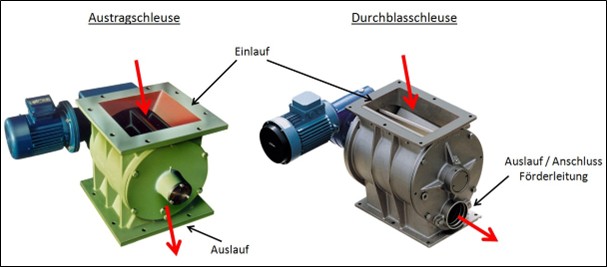
The selection of the appropriate rotary valve type primarily depends on the kind of conveying system in which the valve is to be installed. Under storage vessels, so‑called discharge rotary valves are used. With this type, the material flows from the silo through the inlet chute into the rotor pockets and is then, by rotation of the rotor and assisted by gravity, discharged vertically from the outlet at the bottom into a downstream unit such as a screw conveyor.
In pneumatic conveying systems, blow‑through rotary valves are employed and connected directly to the pneumatic conveying line. In this case, the product is either extracted from the rotor pockets by suction or blown into the conveying line.
The selection of the correct rotary valve, the drive type and the appropriate accessories depends on a number of key criteria:
- Type of material / bulk material properties (bulk density, particle size, abrasiveness, flowability, etc.)
- Material moisture content and temperature
- Required volumetric throughput (cubic metres per hour or litres per revolution)
- Function of the valve as a discharge or blow‑through rotary valve (to define the speed range)
- Daily operating time and number of start/stop cycles per hour
- Required safety certifications such as explosion protection (ATEX)
For example, the filling degree of the rotor pockets depends on the flowability of the material being discharged and on the rotational speed of the rotor. In other words, the lower the flowability of the product, the lower the rotational speed must be in order to achieve optimum filling of the rotor pockets.
Another key aspect in the design of a rotary valve is the abrasiveness of the bulk material. Low rotational speeds result in reduced wear. For highly abrasive materials, rotary valves with large volumes and low operating speeds are therefore recommended.
Five product ranges covering virtually every requirement
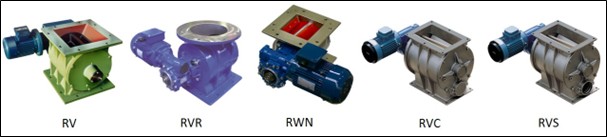
Depending on the type of bulk material and the conveying system, WAM® offers rotary valves for virtually every application. With the RV, RVR and RVC types, WAM® provides universally applicable discharge rotary valves designed for dosing powders, fine‑grained materials or granules. The dosing capacity of these valves ranges from 0.3 to 55 cubic metres per hour at a standard rotor speed of 10, 20 or 30 revolutions per minute.
In versions equipped with a mechanical variable speed drive, the rotor speed can be adjusted manually or via an electrical signal to ensure that the product is fed into the production process at precisely the required rate. Alternatively, fixed drives can be speed‑controlled by means of a frequency inverter.
Specifically developed for wood chips or wood pellets, WAM® designed the RWN series – a discharge rotary valve with increased drive power and a reinforced shaft. In this version, the rotor is made of HARDOX steel to protect the valve against wear. Thanks to the special shape of the rotor blades and a steel shear knife mounted on the housing, jamming of wood chips or pellets is prevented by a clean cutting action. At the same time, the resulting pressure forces are reduced. As this type of rotary valve is also flame‑proof, it additionally serves as a backfire protection device.
In the field of blow‑through rotary valves, WAM® offers the RVS type, which enables a wide variety of organic and inorganic materials to be precisely metered into a pneumatic conveying flow.
In addition to their versatility, WAM® rotary valves are characterised above all by their robust and compact design, as well as by the minimal space required in the respective installation situations.
Versatility through optional accessories
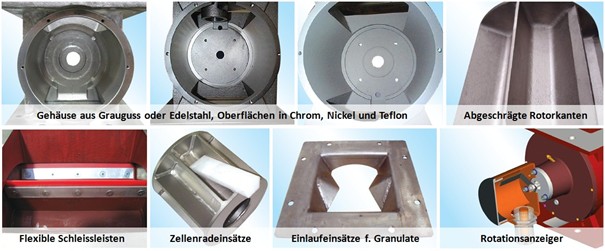
Given the wide range of possible applications and the diverse properties of bulk materials, the key to adaptability lies in the selection of optional accessories. When it comes to meeting individual requirements, WAM® demonstrates flexibility by offering a comprehensive range of additional equipment for each rotary valve series:
- Housing and rotor available in different material versions: grey cast iron or stainless steel, with surface treatments such as chrome, nickel or Teflon®
- Rotor with wear strips made of spring steel, Vulkollan®, Viton®, Teflon® or stainless steel to improve sealing and reduce wear
- Rotor with chamfered rotor blades
- Rotor pocket inserts for cohesive or sticky bulk materials
- Alternative drive solutions: direct drives with constant or variable speed, coaxial drives with chain transmission, various electric motors, as well as versions without drive featuring a free shaft end
- Rotation sensors for monitoring rotor speed
- Explosion protection: ATEX Zone 22 (RV, RVR, RVC, RVS)
WAM® – a strong partner in a global environment
Based in the Rhine‑Neckar region, WAM GmbH was founded in 1986 as the German sales subsidiary of the internationally operating WAMGROUP®. With more than 50 subsidiaries worldwide, around 2,300 employees and a broad product range, WAM® has been one of the world’s leading suppliers of components for bulk material handling systems for over 40 years.
The development, engineering and manufacturing expertise of WAMGROUP® in the field of rotary valves is concentrated within TOREX®, an important subsidiary of the Group. Since 1987, TOREX® has been intensively focused on technologies for the handling of powders and granulates. All products are manufactured using state‑of‑the‑art industrial processes and meet the highest quality standards across a wide range of applications.


